Berlin Chic brings together two words rarely spoken in the same sentence —Holocaust and fashion — to reveal how Nazi “Aryanization” wiped out Berlin’s Jewish fashion world. Reconstructed through rare archives and family legacies, the film restores the industry’s stolen place in history and in today’s global style.
Synopsis
Berlin Chic uncovers one of the twentieth century’s most compelling forgotten stories: the dazzling Jewish fashion world of Berlin — a creative force that gave birth to modern fashion as we know it, then was deliberately erased from history.
At its peak, Berlin rivaled Paris. Jewish designers and manufacturers — comprising nearly seventy percent of the fashion industry — invented ready-to-wear clothing, standardized sizing, and seasonal collections. Then it was all taken away.
With the Nazi rise to power in 1933, a brutal process of boycotts and forced seizures began — what survivors called the “Kristallnacht of the fashion world” — culminating in the darkest of ironies: inside Auschwitz, Jewish seamstresses were forced to sew haute couture gowns for SS officers’ wives while crematorium chimneys burned nearby.
The film follows descendants and historians piecing together erased legacies through rare archives and private collections, restoring a voice to a world that was stolen but never entirely silenced.
About the Director

Sigal Rosh
Sigal Rosh is a leading producer and director, content editor, and researcher in The Israeli documentary film industry;
She has produced in Israel in service of leading International TV channels such as ARTE, TV5, BBC, MSNBC, SBS, Nippon Television Network, and more.
Recently, she completed directing her debut film, Rubina, a Glorious Tragedy, about the actress Hanna Rovina and her daughter Ilana. The film was screened at Docaviv 2025 International Documentary Film Festival and received excellent reviews. She was one of the producers at The Devil’s Confession: The Lost Eichmann Tapes (2022), directed by Yariv Mozer and produced for MGM Studios and Kan 11.
She has produced, co-produced, line produced, and has done the research for numerous documentary films, including: The Junction (2003) by Ilan Ziv for ARTE, Life is a Buss (2003) by Ilan Ziv for National Geographic Channel, Sentenced to Marriage (2004) by Anat Zruya for ARTE, Hijacked (2006) by Ilan Ziv for PBS The American Experience Series, Middle East Blues (2006) for TV5, associate producer and chief editor of If You Were in My Shoes (2006) for KESHET, co-producer of The Ashkenazim (2006) and Aris San (2008) by Dani Dotan for KESHET, producer of Jesus Politics (2008) by Ilan Ziv for ARTE, Exile: A Myth Unearthed (2010) by Ilan Ziv for ARTE, Capitalizim (2015) ARTE, The Fall of a Shah (2010) by Maziar Bahari for BBC, producer of To Err is Human (2019) for Kan 11 and The Red Notebook (2021) for HOT8, both directed by Yariv Mozer and many more. Since 2008, a teacher at The Jerusalem Sam Spiegel Film and Television School.
Artistic Statement
Berlin Chic approaches history through the lens of fashion as culture, innovation, and artistic expression. Rather than a conventional historical or Holocaust narrative, the film examines how style, design, and industrial creativity shaped modern life in pre-war Berlin — and how that cultural force was deliberately erased. Fashion becomes both subject and cinematic language: a way to explore freedom, identity, and modernity, and later, their violent suppression.
Contemporary scenes — in fashion schools, archives, exhibitions, and runways-follow researchers, descendants, and historians, revealing how this legacy still surfaces in today’s culture, often unrecognized.
Archival materials (film, photographs, letters, sketches) are not static illustrations but are restored, colorized, and animated to reactivate within the present-day visual world. Subtle transformations blur temporal boundaries, as modern shop windows and cityscapes momentarily reveal earlier layers beneath them.
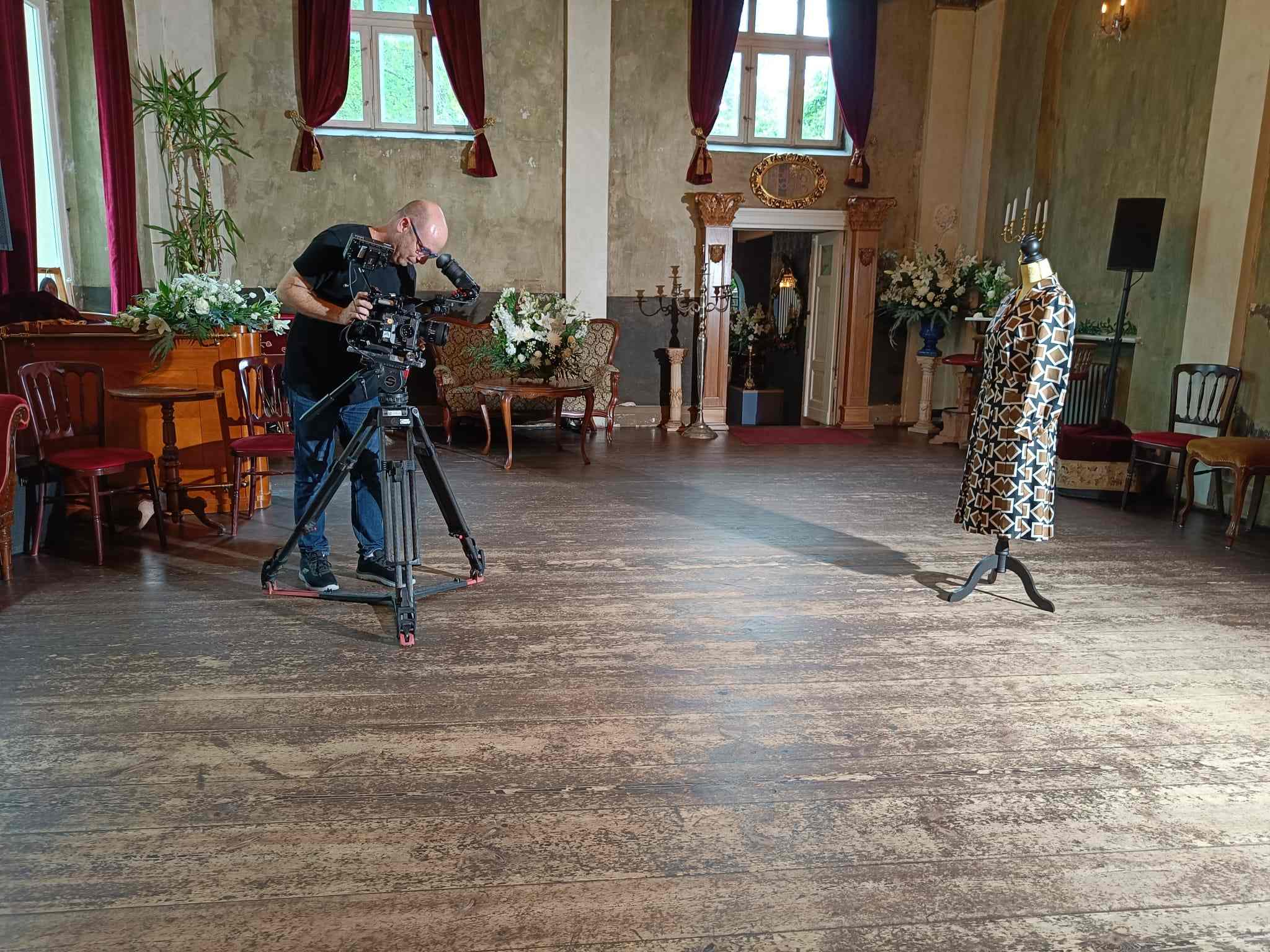
Drawing its aesthetic from fashion photography, with close attention to texture and material, the film was shot across Berlin, Paris, Israel, and the United States.
Year
In production
Film Type
Documentary
Film Length
TBD
Language
Hebrew
German
English
Production Country
Israel
Germany
Director/Producer
Sigal Rosh
Producers
Dorit Hessel
Stav Meron
Rinat Klein
Director of Photography
Roberto Ravitz
Editor
Shauley Melamed
Subject Region
Germany
Production Company
Slutzsky
Funding
Conference on Jewish Material Claims Against Germany
Other Funders
HOT8
ZDF ARTE
Jewish Story Partners
The Israeli Film Fund
Gesher Fund
Stills